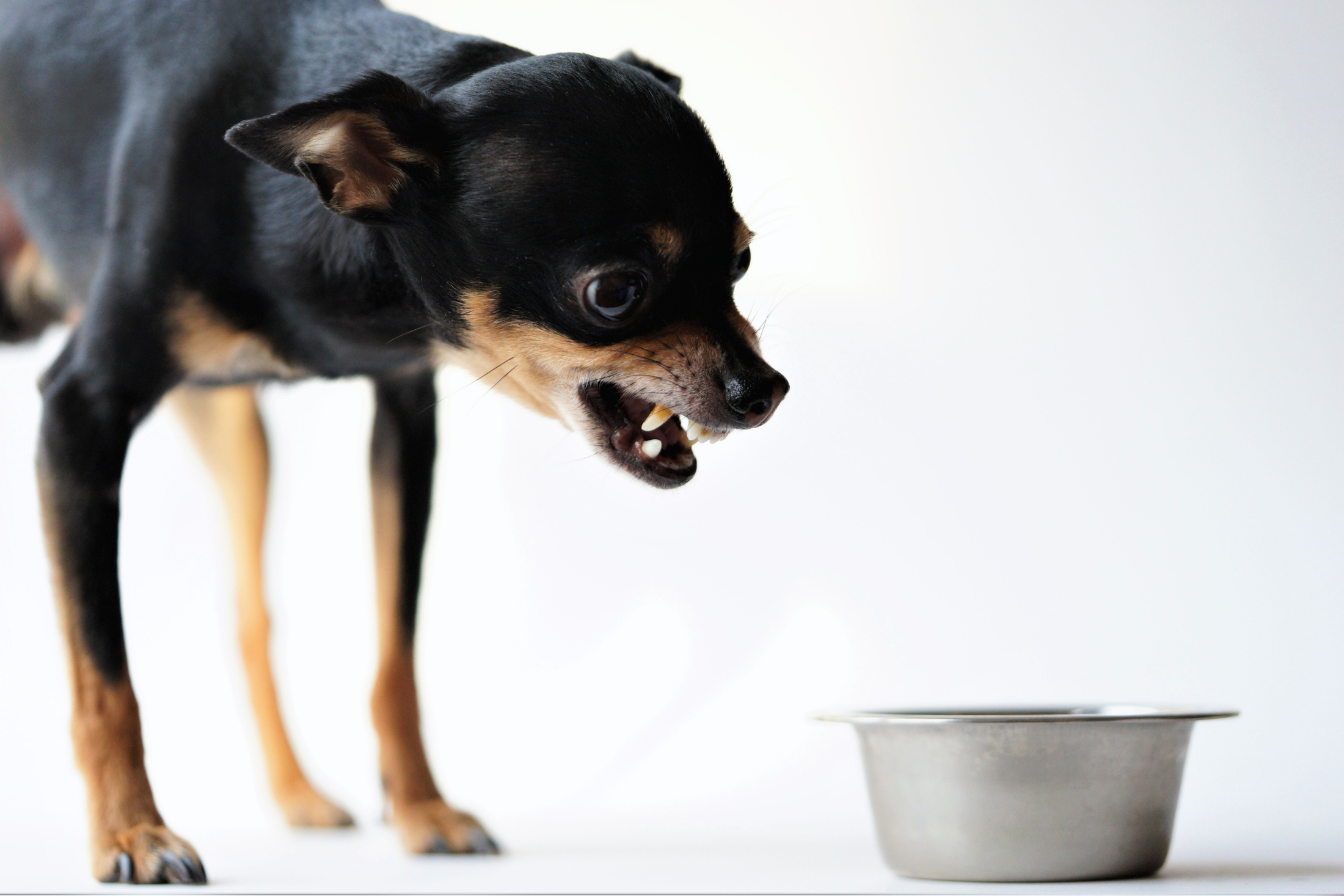
You walked past while your dog was eating, the way you have a thousand times. And this time, your dog froze. Their head dropped low over the bowl, their eyes went hard, and a low growl came out that you’ve never heard from them before.
Maybe it wasn’t the food bowl. Maybe it was a bully stick, a stolen sock, the spot on the couch, or the side of the bed your dog has claimed as their own. Either way, the feeling is the same: a jolt of surprise, a little fear, and a question you don’t quite want to ask… Is my dog turning on me?
No. What you’re seeing has a name — resource guarding — and it’s one of the most common behavior patterns I work with. In 25+ years and more than 6,000 dogs, I’ve seen it in tiny puppies and senior dogs, in rescues and in dogs raised from eight weeks old in loving homes. It’s understandable, it’s workable, and in most cases it improves a great deal once owners understand what’s actually driving it. Here’s what it really means, how to recognize it early, and what to do (and not do) starting today.
What resource guarding actually is
Resource guarding is a dog’s attempt to keep something they value from being taken away. That’s it. Food, chews, toys, resting spots, even a favorite person can all become “resources” a dog feels the need to protect.
It’s worth saying clearly: this is natural canine behavior. For a dog’s ancestors, protecting food was a survival skill, not a personality flaw. What makes it a problem in our homes isn’t that the instinct exists — it’s how intense it gets, who it’s aimed at, and how the people around the dog respond to it.
It’s also not a bid to be “the boss.” The outdated idea that a guarding dog is challenging you for rank has led a lot of good owners toward exactly the wrong response. A dog guarding a bowl isn’t asking for power. They’re worried about losing something. That’s a very different problem, and it calls for a very different solution.
The warning ladder: how guarding usually shows up
Very few dogs go straight from relaxed to biting. Most move up a predictable ladder of signals, and the earlier you learn to see them, the more room you have to help. Watch for:
- Eating faster when someone approaches
- Freezing or a sudden stillness over the bowl or object
- Body lowering or curving over the item, head dropped
- A hard stare, or “whale eye,” where you can see the whites of the eyes as the dog watches you without turning their head
- Lip lifting to show teeth
- Growling
- Snapping, a bite at the air, or a quick nip that doesn’t connect hard
- Biting
Many owners only notice the growl and miss everything below it. But that freeze, that hard eye, that sudden speed-up in eating — those are your dog’s polite, early ways of saying “please don’t.” When those quieter signals get ignored, or punished, a dog learns they don’t work and starts skipping straight to the louder ones.
It’s not always the food bowl
The food bowl is where most owners first notice guarding, but it’s rarely the only place it shows up. Some of the most common resources I see dogs protect:
- High-value chews — bully sticks, rawhides, antlers, marrow bones
- “Found” or stolen items — socks, tissues, food dropped on the floor, things pulled from the trash
- Toys — especially a single favorite
- Resting spots — the couch, a dog bed, your bed, a spot under the table
- Spaces — like a crate or a doorway
- People — a dog who stiffens or growls when someone approaches their favorite person
Stolen items deserve a special mention. A dog who grabs a sock and gets chased around the house for it learns very quickly that whatever they’re holding is incredibly valuable — and that people are coming to take it. That’s how a lot of guarding starts.
Why dogs start guarding
There’s rarely just one cause. In assessments, these are the threads I’m usually pulling on:
History and early experience. Dogs who had to compete for food as puppies, lived in a shelter or a crowded home, or went through a period of not having enough often learned that resources were scarce and needed protecting.
Learned experience with people. This is the big one, and it’s nobody’s fault — it usually comes from well-meaning advice. Taking food away “to show them who’s in charge,” reaching into the bowl to “get them used to it,” or grabbing things out of a dog’s mouth all teach the same lesson: when a person approaches, I lose something. The dog’s response is completely logical from their point of view.
Pain or a medical issue. Dental pain, mouth injuries, digestive discomfort, and general soreness can all make a dog more protective and less tolerant, especially around eating and resting. If guarding appears suddenly, especially in an older dog, a vet visit comes first. I walk through the medical piece, and five other common causes of sudden aggression, in Why Is My Dog Suddenly Aggressive? A Behaviorist’s Framework.
Household changes. A new baby crawling toward the bowl, a new dog in the house, a move, or a change in routine can turn a dog who was mildly protective into one who’s genuinely worried.
Value going up. Sometimes the item itself is the trigger. A dog who’s perfectly relaxed with kibble might guard a raw bone intensely. Value is in the eye of the dog.
Is resource guarding dangerous?
It can be, and it deserves to be taken seriously — but it sits on a spectrum. A dog who eats a little faster when you walk by is in a very different place from a dog who has bitten over a toy.
Children are the group I worry about most. They move quickly, they get down at a dog’s eye level, they reach for things, and they often don’t read the early warning signs. Many bites to children in the home happen around food, toys, and resting spots. If you have kids in the house or visiting, guarding needs a management plan right away, even if the behavior seems mild.
If a bite has already happened, start with My Dog Bit Someone — What to Do Right Now for the immediate steps, then come back here.
What NOT to do
Most of the advice that makes guarding worse sounds reasonable at first. Please avoid:
- Taking the bowl away to “prove” you can. It confirms your dog’s worst fear: people approaching means losing food.
- Sticking your hand in the bowl while they eat. Same lesson, delivered daily.
- Punishing the growl. A growl is your dog’s warning system. Punish it, and you don’t remove the worry — you remove the warning. The next step up the ladder comes with no notice at all.
- Chasing your dog to get a stolen item back. It turns the item into a prize and the chase into a game with high stakes.
- “Testing” your dog to see how bad it is. Every rehearsal makes the behavior stronger.
What to do starting today
You don’t need to fix this overnight. You need to stop it from getting worse while you get a real plan. Here’s where to start:
Manage the situation so guarding doesn’t get practiced. Feed your dog in a separate room, behind a baby gate, or in a crate with the door closed, and let them eat in peace. If you have multiple dogs, feed them apart. Pick up high-value chews and only give them when your dog can enjoy them alone.
Give your dog space while they have something. For now, nobody approaches, reaches over, or walks closely past a dog who is eating or chewing. That one change alone often brings the tension in the house down considerably.
If you have to get something back, trade — don’t take. If your dog has something dangerous, toss a handful of something better a few feet away and pick up the item calmly once they’ve moved off it. No chasing, no grabbing.
Teach the whole household the rules. Especially children. A simple “we never bother a dog who is eating, chewing, or resting” protects everyone.
Start a log. What was guarded, who approached, what the body language looked like, and how close the person was when your dog first reacted. That distance number is surprisingly useful in an assessment.
Book a vet visit if the guarding is new or getting worse. Rule out pain before anything else.
What changes when you have a real plan
Here’s what I tell every client: I’m not here to train your dog. I’m here to help you lead your dog. With resource guarding, leadership doesn’t mean taking things away. It means becoming the person your dog trusts completely around the things they value — calm, predictable, and never a threat to their food. When a dog learns that a person approaching means something good is coming, not that something good is leaving, the whole picture starts to change.
The specifics of getting there depend entirely on your dog: what they guard, how intensely, toward whom, and why it started. That’s why generic checklists so often stall. A plan for a puppy who stiffens over a chew looks nothing like a plan for an adult rescue who has bitten over a resting spot.
This is also one of the issues where working virtually is a natural fit. Guarding happens at mealtimes, on the couch, and in the corners of your home, so we work right where it happens. Your dog doesn’t need to perform on camera, and there’s no stranger standing near their bowl, raising the stakes. The most important person in the session is you. If you’re curious how that compares to an in-person visit, I’ve laid it out here: Online vs. In-Person Dog Training: An Honest Comparison from a 25-Year Behaviorist.
Why vets send me their guarding cases
For more than 25 years, I’ve worked resource guarding in nearly every form: dogs guarding food from toddlers, dogs guarding a single tennis ball from the other dog in the house, dogs who guarded their owner from a new spouse, and dogs who guarded tissues pulled from the trash so intensely that the family was afraid to walk past them.
Many of those cases came to me after previous training had made things worse — usually because the dog had been “corrected” for growling. Veterinarians and other animal professionals have referred these cases to me for decades because guarding sits right where behavior, history, and sometimes pain meet, and getting the root cause right is everything.
What your dog is trying to tell you
A dog who growls near the food bowl isn’t a bad dog or a dominant dog. They’re a worried dog telling you, as clearly as they know how, that they’re afraid of losing something. Listen to that warning, manage the situation so it isn’t practiced, avoid the old advice that makes it worse, and get a plan built around your specific dog.
From there, the plan has to fit your dog. A Foundational Behavior Session is where that plan starts. Together, we’ll figure out what your dog is guarding, why, and exactly what to do about it, so mealtime (and every time) feels calm again.